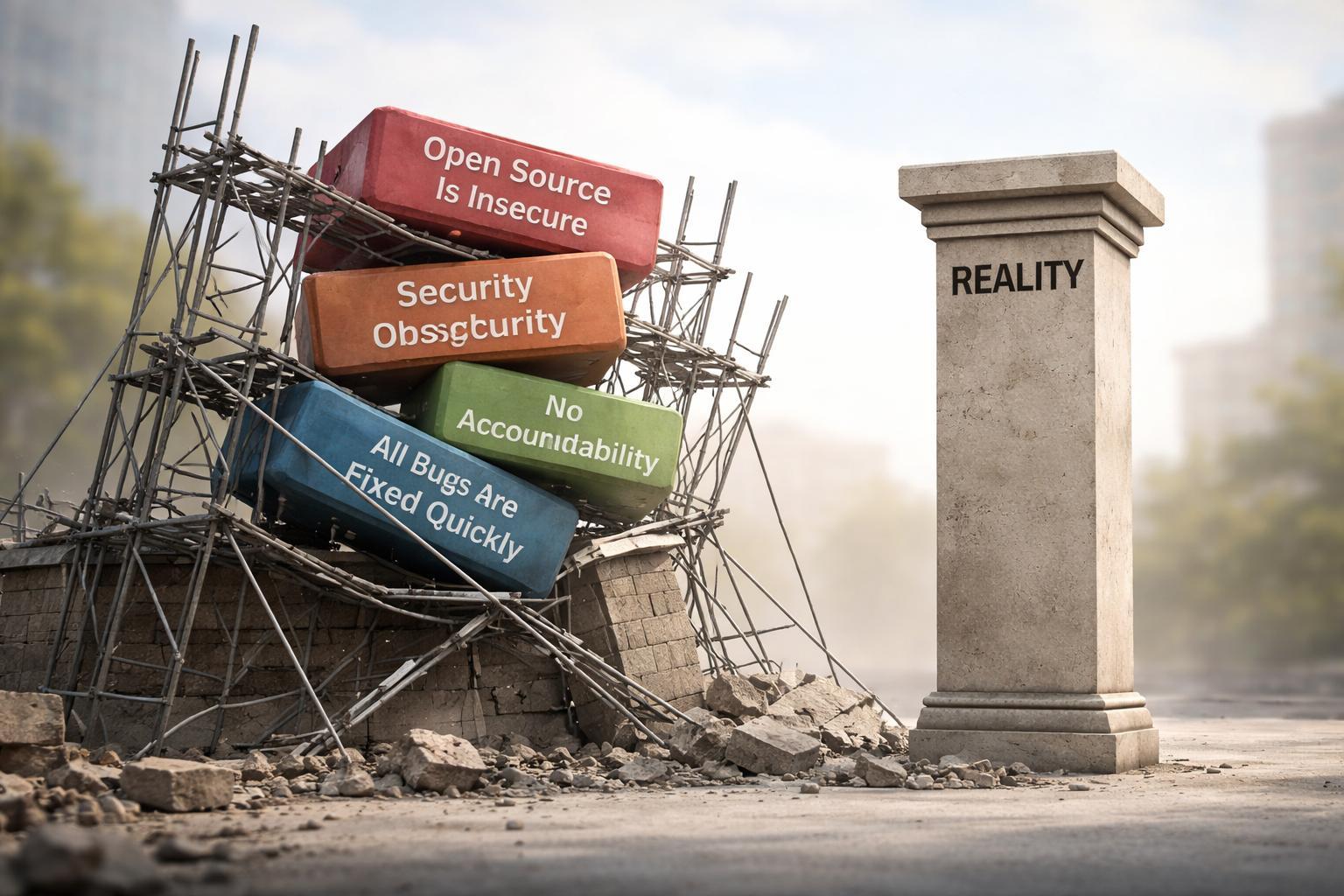
These myths persist because they allow teams to avoid uncomfortable conversations about accountability. When your auditor asks who owns security for the 247 open source packages in your application, pointing at "the community" doesn't satisfy PCI DSS v4.0.1 Requirement 6.3.2 or SOC 2 Type II CC7.2. Yet organizations continue to rely on assumptions that create gaps in their security posture.
Myth 1: "The Maintainer Owns Security for Their Package"
Reality: The maintainer writes code. You own the risk of running it in production.
When a vulnerability appears in a library you're using, the maintainer has no obligation to fix it on your timeline—or at all. Many maintainers are volunteers contributing in their spare time. Expecting them to meet your compliance deadlines is unrealistic.
Your compliance framework doesn't care about maintainer availability. ISO 27001 Control 8.8 requires you to manage technical vulnerabilities in systems you operate. NIST 800-53 Rev 5 SI-2 mandates flaw remediation regardless of whether the flaw originated in your code or someone else's.
Practical ownership means: you monitor for vulnerabilities, assess impact against your risk register, patch or mitigate within your defined SLAs, and document the decision trail. The maintainer is a potential resource, not your security team.
Myth 2: "High Security Knowledge Among Maintainers Means Secure Code"
Reality: Security knowledge doesn't translate to security implementation under resource constraints.
Snyk's survey asks maintainers to rate their security knowledge out of 10, but that number tells you little about the package's actual security posture. A maintainer might score themselves an 8/10 on security knowledge while shipping code with hardcoded credentials due to time constraints.
Security requires time, tooling, and sustained attention. Knowledge is necessary but insufficient. Your vetting process should examine the package's actual security artifacts: Does it have automated dependency scanning? When was the last security-focused commit? How quickly were previous CVEs addressed? What's the maintainer's response pattern to security issues?
Myth 3: "CVE Databases Give You Complete Vulnerability Coverage"
Reality: CVE coverage for open source is inconsistent, delayed, and often missing context you need for risk decisions.
CVE assignment is voluntary. Many vulnerabilities in open source packages never receive CVE identifiers. Others get assigned months after the vulnerability becomes public knowledge. The CVE description often lacks the detail you need to assess exploitability in your specific environment.
This creates a compliance problem when your framework requires "timely identification of security vulnerabilities" (PCI DSS v4.0.1 Requirement 6.3.1). Relying solely on CVE feeds means you're working with incomplete, delayed data.
Effective vulnerability tracking requires multiple feeds: GitHub Security Advisories, language-specific security mailing lists, the package's own issue tracker, and specialized databases like OSV (Open Source Vulnerabilities). You need tooling that aggregates these sources and correlates them with your actual dependency tree.
Myth 4: "Security Responsibility Should Live with the Team Using the Package"
Reality: Distributed responsibility creates accountability gaps that auditors will flag.
The "you built it, you secure it" model sounds empowering until you have multiple teams using different versions of the same vulnerable package, each making independent risk decisions. Your compliance officer sees this as ungoverned chaos.
Security ownership needs a hub-and-spoke model. A central function (security, platform engineering, or a dedicated open source program office) maintains the approved package list, monitors for vulnerabilities, assesses organizational impact, and sets remediation timelines. Individual teams implement fixes based on centralized intelligence and policy.
This isn't about controlling developers. It's about having a single source of truth when your auditor asks: "How do you ensure consistent vulnerability response across all applications?"
Myth 5: "Automated Scanning Solves Your Open Source Security Problem"
Reality: Scanning finds issues. Your process determines whether they get fixed.
Dependency scanning tools generate findings. Without defined ownership, triage processes, SLAs, and exception handling, those findings sit in a backlog until your next audit. The tool doesn't tell you whether a vulnerability in a development-only dependency matters for production compliance. It doesn't prioritize the remote code execution in your authentication library over the denial of service in a logging utility.
NIST Cybersecurity Framework v2.0 function ID.RA-01 requires you to identify and document asset vulnerabilities. Your scanning tool is input to a human-driven process that includes risk assessment, prioritization, remediation tracking, and exception approval.
Effective scanning programs define: who triages new findings within what timeframe, what risk scoring methodology you use beyond CVSS, what your remediation SLAs are by severity, who can approve exceptions, and how you track remediation progress.
What to Do Instead
Build an open source security program with clear accountability:
Establish a package approval process. Before a package enters your codebase, evaluate its maintenance activity, security track record, and license compatibility. This prevents the "we're already using it in production" conversation during your next audit.
Assign a central monitoring function. One team watches for vulnerabilities across all approved packages, assesses organizational impact, and triggers remediation workflows. They ensure nothing falls through the cracks.
Define remediation SLAs by environment and severity. Critical vulnerabilities in production-facing code get 48-hour SLAs. Medium findings in internal tools get 30 days. Document the rationale so auditors understand your risk-based approach.
Create an exception process with expiration dates. Sometimes you can't patch immediately. Document why, what compensating controls you've implemented, who approved the exception, and when you'll revisit it.
Track metrics that matter for compliance. Mean time to remediation by severity, percentage of packages on supported versions, exception backlog age. These numbers tell auditors you're managing the risk, not just finding it.
Security ownership in open source isn't about making maintainers responsible for your compliance. It's about building internal processes that treat open source dependencies as the third-party risk they are—with the same rigor you apply to vendor software, because your auditor certainly will.