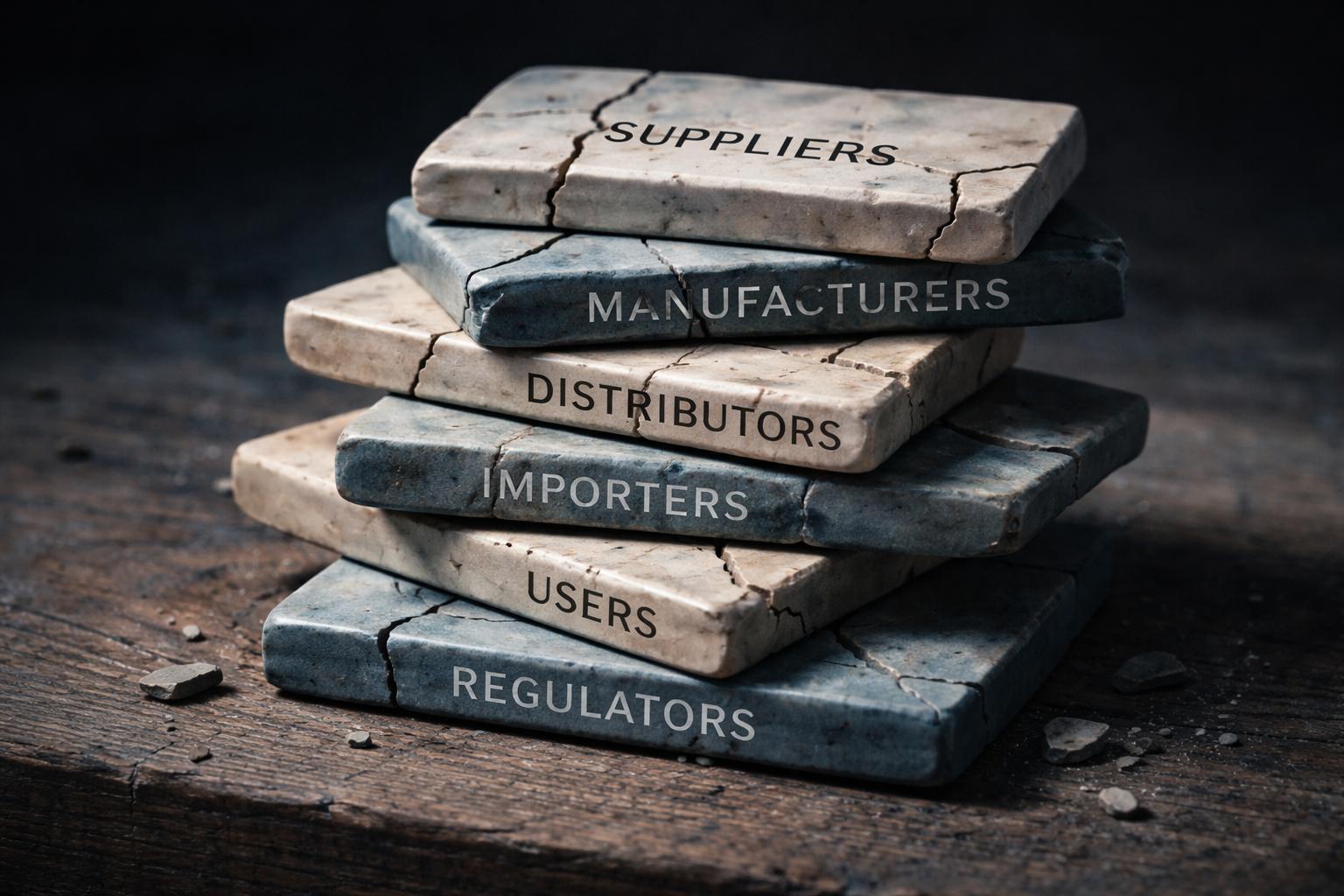
Most discussions about AI coding tools focus on whether the generated code is "secure." That's the wrong question. The real risk isn't what the AI writes at the moment, it's what it pulls in from the ecosystem.
These myths persist because AI coding assistants feel like magic. You describe what you need, and working code appears. But that code doesn't materialize from nothing. It imports libraries, calls APIs, and creates dependency chains. Your security posture depends on understanding what's really happening behind that autocomplete suggestion.
Myth 1: "AI-generated code is the main security risk"
Reality: The dependencies are the risk surface.
When an AI assistant generates a Flask application or a data processing pipeline, the code itself might be perfectly functional. The vulnerability enters when it imports packages you've never heard of or pulls in transitive dependencies six layers deep.
The Department of War's recent Call for Solutions for AI-enabled coding emphasizes security, data handling, and IL5 compliance for defense-grade software. They're not worried about syntax errors. They're worried about supply chain integrity.
You need to treat AI-suggested dependencies the same way you'd treat a junior developer's pull request that adds fifteen new packages. Run it through your dependency scanning tools. Check for known CVEs. Verify the package maintainer's identity. The fact that an AI suggested it doesn't make it safer.
Myth 2: "We can review AI-generated code the same way we review human code"
Reality: AI code requires dependency-first review.
Your code review process probably focuses on logic, edge cases, and security patterns. That works when a developer adds a dependency intentionally and understands its purpose. AI assistants don't work that way.
Consider a scenario where your team asks an AI to "add authentication." It might pull in a package that does exactly what you asked, but also includes deprecated cryptographic functions or unmaintained sub-dependencies. The AI doesn't know your organization banned that library two years ago after a security incident.
You need a review checklist that starts with dependencies:
- Is this package on your approved list?
- When was it last updated?
- What's its transitive dependency tree?
- Does it require network access or file system permissions you didn't expect?
Only after clearing those questions should you review the code logic itself.
Myth 3: "Compliance frameworks don't cover AI-generated code"
Reality: They already do, you just need to map the controls.
ISO 27001 Annex A.8.31 covers separation of development, testing, and operational environments. That applies whether a human or an AI wrote the code. PCI DSS v4.0.1 Requirement 6.3.2 requires security testing throughout the development lifecycle. It doesn't care about the author.
The challenge isn't that AI code falls outside compliance frameworks. It's that your current implementation of those controls might not catch AI-specific risks. For example, if your Requirement 6.3.2 testing only checks for SQL injection and XSS, but doesn't scan dependency manifests, you're not actually meeting the requirement's intent.
For teams working under IL5 compliance or similar defense-grade standards, the data handling requirements become critical. An AI might suggest a logging library that sends telemetry to an external service. That's a compliance violation before it's a security issue.
Myth 4: "We can block risky AI suggestions at the IDE level"
Reality: Governance happens at the build pipeline, not the editor.
IDE plugins that flag suspicious AI suggestions feel like a solution. They're not. Developers can ignore warnings, work in different editors, or paste code from external AI tools.
Your enforcement point is the CI/CD pipeline. This is where you:
- Run SBOM generation on every commit
- Compare new dependencies against your approved list
- Block builds that introduce packages without approval workflow
- Require security team sign-off for any new external dependency
This isn't theoretical. If you're working toward SOC 2 Type II certification, your auditors will ask how you ensure that only approved third-party components enter production. "We trust our developers to check" isn't an acceptable answer.
Myth 5: "AI coding tools need special security tools"
Reality: You need better dependency governance, period.
The security industry loves to sell "AI-specific" solutions. You don't need them. You need the same dependency management practices you should have already implemented:
- Maintain an approved package registry (Artifactory, Nexus, or equivalent)
- Require all dependencies to be pulled from that registry
- Run regular CVE scans against your dependency tree
- Have a documented process for evaluating and approving new packages
The difference with AI tools is volume. A developer might add three new dependencies per month. An AI assistant might suggest thirty. Your governance process needs to scale, but the principles don't change.
What to do instead
Start with visibility. Generate SBOMs for every application and track your dependency surface area. You can't govern what you can't see.
Then implement a tiered approval system. Low-risk dependencies (updated versions of packages you already use) can be auto-approved. New packages require security review. Packages that access sensitive resources or make network calls require architecture review.
Document your AI coding assistant policy. Not "don't use AI" but "when you accept an AI suggestion that adds dependencies, here's the approval workflow." Make it clear that the developer accepting the suggestion owns the security review.
Finally, treat this as a supply chain security problem, not an AI problem. NIST 800-53 Rev 5 control SA-12 addresses supply chain protection. Map your AI coding workflow to those controls. If you can demonstrate that AI-suggested dependencies go through the same vetting as manually-added ones, you're compliant.
The goal isn't to slow down development. It's to ensure that when your team ships faster with AI assistance, you're not unknowingly expanding your attack surface. Speed matters, but only if you're still secure at the end.