When Socket alerted on malicious Docker images in the official 'checkmarx/kics' repository—including a new tag v2.1.21—and compromised VS Code extensions (checkmarx/[email protected] and 1.19.0), security teams faced an immediate question: How should you consume third-party developer tooling going forward?
The attack involved a backdated commit injected into the Checkmarx/ast-vscode-extension repository, demonstrating that even official sources can be compromised. This isn't a theoretical risk—it's a decision you need to make right now for every tool your developers use.
The Decision You Are Facing
You need to choose a consumption model for third-party developer tools, CI/CD components, and extensions. This includes Docker images, IDE plugins, CLI tools, and pipeline integrations. Your choice determines your exposure to supply chain compromise and your ability to meet controls like PCI DSS v4.0.1 Requirement 6.3.2 (secure development practices) and NIST 800-53 Rev 5 control SA-12 (supply chain protection).
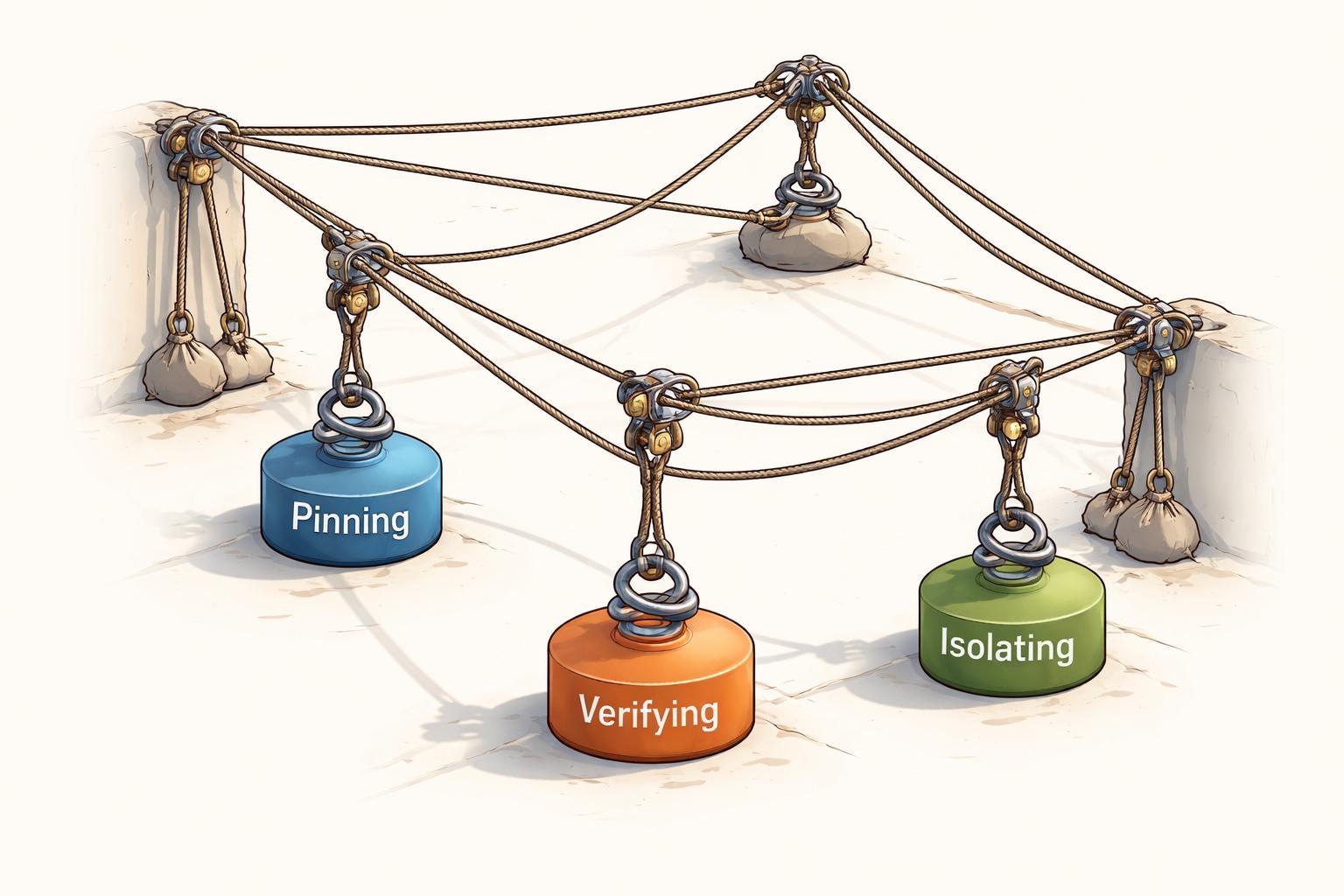
The three viable paths are:
- Pin and verify specific versions with cryptographic validation
- Verify signatures from trusted publishers before each use
- Isolate in controlled environments with restricted network access
There is no fourth option of "trust and auto-update." That model fails both security and compliance requirements.
Key Factors That Affect Your Choice
Compliance scope: If you're under PCI DSS v4.0.1, you must demonstrate secure SDLC practices per Requirement 6.2.4. If you're pursuing SOC 2 Type II, your auditor will examine change management controls (CC8.1). These requirements don't prescribe a specific approach, but they demand evidence of intentional security decisions.
Team size and automation maturity: A 50-person engineering team has different operational constraints than a 2,000-person platform team. The Checkmarx incident affected both individual developers (via VS Code extensions) and automated pipelines (via Docker images). Your mitigation strategy must match your scale.
Tool criticality: A linting tool that runs locally carries different risk than a container image that executes in your production build pipeline with access to secrets and artifact repositories. The backdated commit technique used in this attack specifically targeted the latter.
Update velocity: Some tools require weekly updates for new vulnerability signatures. Others are stable for months. Your consumption model must accommodate legitimate updates without creating a bypass for malicious ones.
Path A: Pin to Immutable Identifiers
Choose this when: You have automated pipelines consuming Docker images, GitHub Actions, or other remotely-fetched components. You need reproducible builds. You're subject to change control requirements.
Implementation: Reference tools by SHA-256 digest, not by tag. For Docker: checkmarx/kics@sha256:abc123... instead of checkmarx/kics:v2.1.21. For GitHub Actions: actions/checkout@8e5e7e5... instead of actions/checkout@v3.
Why this works: Tags are mutable. The v2.1.21 tag in the Checkmarx incident was replaced with malicious content. Digest references are cryptographically bound to specific image layers. An attacker who compromises a repository cannot change what a SHA reference points to—they can only push new content with a different SHA.
Requirements satisfied:
- PCI DSS v4.0.1 Requirement 6.3.2 (development practices based on industry standards)
- NIST 800-53 Rev 5 CM-2 (baseline configuration)
- ISO/IEC 27001:2022 Annex A.8.31 (separation of development, testing, and production)
Operational cost: You must actively update pinned references when you want new versions. Create a scheduled review process—weekly or biweekly—where you evaluate new releases, test them in staging, and update your pins. This is not optional maintenance; it's how you maintain security while preserving stability.
When this fails: If your tool vendor doesn't publish signatures or SBOMs, you're pinning to unverified content. You've eliminated tag mutation risk but not initial compromise risk.
Path B: Verify Signatures at Consumption Time
Choose this when: You need more flexibility than pinning allows. Your tools publish signed releases with public keys. You have infrastructure to perform verification before execution.
Implementation: Configure your pipeline to verify signatures before using any external component. For Docker, use Docker Content Trust (Notary). For VS Code extensions, verify the publisher signature matches expected keys. For package managers, verify GPG signatures on downloaded artifacts.
Why this works: Even if an attacker compromises a repository, they cannot forge a valid signature without the private key. The backdated commit technique used against Checkmarx would fail signature verification if properly implemented.
Requirements satisfied:
- PCI DSS v4.0.1 Requirement 6.3.3 (review of custom code prior to release)
- NIST 800-53 Rev 5 SA-12 (supply chain protection)
- SOC 2 Type II CC7.2 (system monitoring)
Operational cost: You need infrastructure to fetch and validate public keys, handle key rotation, and fail safely when verification fails. You also need monitoring to detect when previously-valid signatures become invalid—this could indicate compromise or legitimate key rotation.
When this fails: If the vendor's signing infrastructure is compromised (as happened in the SolarWinds incident), signatures become meaningless. You need a secondary control: limit what signed-but-compromised tools can access.
Path C: Isolated Execution Environments
Choose this when: You cannot verify tool provenance with confidence. The tool requires network access or elevated privileges. You're using tools from vendors without mature security programs.
Implementation: Run third-party tools in containers or VMs with explicit network policies. Use tools like gVisor or Firecracker for additional isolation. Implement egress filtering so tools can only reach their documented API endpoints—not arbitrary internet destinations.
For the Checkmarx scenario: A properly isolated environment would have prevented credential exfiltration even if the malicious code executed. The attacker's payload would fail to reach command-and-control infrastructure.
Requirements satisfied:
- PCI DSS v4.0.1 Requirement 6.4.3 (scripts loaded and executed only from trusted sources)
- NIST 800-53 Rev 5 SC-7 (boundary protection)
- ISO/IEC 27001:2022 Annex A.8.20 (networks security)
Operational cost: You need container orchestration or VM management. You need to maintain allowlists of legitimate network destinations. You need monitoring to detect when tools attempt unexpected network activity.
When this fails: If the tool legitimately needs access to your source code, secrets, or build artifacts, isolation only limits lateral movement—it doesn't prevent the initial compromise.
Summary Matrix
| Approach | Best For | Prevents Tag Mutation | Prevents Initial Compromise | Detects Runtime Anomalies | Operational Overhead |
|---|---|---|---|---|---|
| Pin to SHA | CI/CD pipelines, reproducible builds | Yes | No | No | Medium - requires scheduled updates |
| Verify Signatures | Tools with mature signing, flexible update needs | Yes | Partial - depends on key security | No | Medium-High - requires key management |
| Isolate Execution | Untrusted tools, high-risk operations | No | No | Yes - if monitoring configured | High - requires container/VM infrastructure |
Recommended combination: Pin your CI/CD pipeline dependencies to SHAs. Verify signatures on developer workstation tools. Isolate anything that processes untrusted input or requires elevated privileges.
The Checkmarx incident succeeded because organizations relied on mutable tags and trusted repository names. Your response should address both: make your references immutable and verify what those references point to. Neither control alone is sufficient.